Posts

Showing posts with the label internet

What we now know about news and news revenue in the digital world

There has now been enough experience and research to draw conclusions about how news is transitioning to the digital world and what it means for news companies. If one objectively views the developments, one sees that the current developments are is neither as bleak as some journalists portray them nor as rosy as some digerati frame them. Instead, we have reached a point where digital news is becoming workable in commercial terms, but is not yet mature enough to erase the industry's business challenges. News consumption in the digital environment is significant and audience reach is now 5 to 10 times larger across digital platforms than for print editions of most newspapers.   Many large news organizations are now generating 15-25 percent of their revenue from online, tablet, and smartphone platforms and benefits are starting to appear for some mid-sized players as well. If we look at what has occurred in the past decade, there are some important lessons to embrace about news ...
Changing frequency of newspaper publication is not a sign of the apocalypse

The number of newspapers that have reduced their publication frequency in response to market changes and economic conditions continues to rise. This year the  Times-Herald in Newnan, Georgia shifted from 7 days a week to 5 days per week. The New Orleans Times-Picayune moved to 3-day per week schedule, as has The Patriot-News in Harrisburg, Pa., and many papers in the Advance Publications group. In doing so, the papers are bolstering their digital publications and producing in physical form only on days that most interest retail advertisers. From the financial standpoint, these moves make a great deal of sense. Reactions to the changes have ranged from disbelief to resignation in the journalism community. Many have bemoaned the loss of dailies and argued non-dailies cannot possibly serve their communities as well. That argument is problematic, of course, because there have typically been 3-4 times more weeklies than dailies in the U.S. and many have done far better jobs...

NBC's Olympic Coverage Shows Audience Expectations Aren't in Its Cross Media Strategy

NBC’s Olympic coverage in the U.S. reveals the conflict media companies face as they try to simultaneously manage traditional media delivery and digital distribution. The company is getting it right with the traditional broadcasts, garnering excellent audiences and more than $1 billion in advertising—a figure that surprised even its most optimistic executives and may allow the broadcaster to break even on the games which have traditionally been a loss leader for the company. The company is also giving audiences more coverage than every before by streaming additional content on cable channels and digital live streams. These are provided on platforms that consumers have come to expect will give them the power to choose when, where, and on what device they will be viewed.   In order to support its traditional, advertising supported services, however, NBC has used tape delays on the broadcast services and has excluded many sports or blacked them outs on live streams—ange...

Facebook's business problems are symptomatic of many large digital firms

Facebook is wrestling with a business challenge more traditionally found in legacy media: how do you translate consumers that don’t think they have a commercial relationship with you into relationships that that other firms will pay for? Despite 955 million active users and increasing revenues, the company has lost a third of its share value since its IPO in the spring.   The exuberance that surrounded its IPO and overpriced its shares has worn off and investors are realizing that being big isn’t enough to ensure business success. Its latest earnings reports show the firm lost money, $157 million, in the second quarter on income of $1.18 billion. Facebook’s challenges are symptomatic of a long line of “successful” digital firms that are experiencing monetization problems, including Yahoo, You Tube, AOL, and Twitter. Despite large numbers of users globally, they still lack effective business models to generate revenue levels congruous with their size. They may provide...

Digital journalism reaches sustainability, but transitional business problems interfere

The income streams of digital news providers continue to grow and many have now reached the point of sustainability. Fundamental financial and business problems, however, are keeping publishers from moving out of print and becoming digital-only operators. This leads many publishers and journalists to continue bemoaning the fact that digital media do not provide as much income as print and many still argue that organized, regular newsgathering and distribution cannot survive in a digital-only environment. They point to the fact that digital advertising produces only about 15 percent the income of print advertising—largely because it does not appeal to retail, display advertisers--and that paid circulation for digital products is growing slowly. Their analysis is flawed, however, because publishers do not require as much revenue online as offline because the costs of digital operation are so different. Editorial operations account for only about 10-15 percent of total costs of opera...

Letting go: Making sense of social magazines and news readers

Applications that aggregate articles based on what others in one’s social network are reading and reformat them into an attractive magazine and presentation formats are growing in popularity, but they are raising concern among some publishers. The processes build upon the referral and curating functions of colleagues and friends in social networks and reduce the need for users to go to multiple sites for content on their own. Some of the best known social magazines are Flipboard, Newsmix, Currents, and Pulse. Some publishers are starting their own social reading apps, such as New York Times that has a Facebook app pulling together stories that friends have read in NYT. Many publishers are fearful of these developments, however, because they represent another step away from publishers controlling when, where, and how readers use their content, reduce the impact of the publishers’ brand strategies, and diminish control over the presentation and marketing of their content. But publish...

The thorny problem of media pluralism

The term pluralism is regularly used in critiques of media and in arguments for public intervention. It is employed so loosely, however, that it allows varied interpretations to be attached and this makes it highly challenging to turn general support for the concept into specific policy. Much of the lack of clarity is the consequence of indefiniteness of the term and because it is used as a proxy for more involved concepts. The term is derived from “plural”, an indistinct quantitative concept indicating the existence of more than a single thing and plurality itself merely indicates a state of being numerous. This alone allows the term plurality to be used in various ways when applied to media. For some it means a plurality of media outlets. This is indicated by having multiple types of media and multiple units of each media and the existence of a range of print, broadcast, satellite, and Internet content providers can represent pluralism. For other observers pluralism means plurality i...

MySpace Sale Underscores the Risks of Exuberant Digital Investments

The decision by News Corp. to dump MySpace once again reveals the risks of over exuberance toward digital companies that do not have a proven business model or long-term customer loyalty. There are plenty of digital investments that meet those requirements, but a number of the most hyped firms moving toward IPOs and acquisitions do not. They need to be considered with hard headed pragmatism. MySpace was launched 2003 and rapidly became the toast of the digital world as a social networking site and “the place” for musical stars and fans to connect. By 2005 it was the fifth most visited site on the Internet. New Corp., which was anxious to benefit from growth in digital media, jumped at the opportunity to acquire the service and paid $580 million in 2005. It was an enormous price for a company with an unclear revenue potential. Within two years MySpace had grown to be the world’s number one social networking site and was receiving 100 million unique monthly visitors. But it still had rev...

Google, Newspaper Archives, and the Business of Cultural Heritage

Google announced this month that it is ending its ambitious project to digitally archive newspapers. The project to scan the archives of the nation’s newspapers and make them available online as a searchable historical record was announced in 2008 with the level of hubris only found in online enterprises. "Our objective is to bring all the world's historical newspaper information online,” said Adam Smith, director of product management at Google, announcing the project. Those lofty aims were echoed by Punit Soni, manager of the newspaper initiative: “As we work with more and more publishers, we'll move closer towards our goal of making those billions of pages of newsprint from around the world searchable, discoverable, and accessible online…."Over time, as we scan more articles and our index grows, we'll also start blending these archives into our main search results so that when you search Google.com, you'll be searching the full text of these newspapers as w...

Editing, the Richness of Content, and the Current Limits of Web and Social Media

Editors matter. The March 28-April 4, 2011, edition of the struggling news magazine Newsweek —which I admittedly have not read in years— provides some of the finest articles I have read in many months, illustrates the limits of online and social media, and shows why editors matter. There is great benefit from both edited and unedited media and I don’t believe they have to be seen in dichotomous choices for the future of media. But I believe those who argue they don’t need to edited media doom themselves to narrowness and ignorance. If I relied only on the links I receive daily from colleagues on Facebook, my news alerts for topics of interest, or digital listings of stories, I would miss the most important contribution of edited media—the service editors provide by reviewing and thinking about the world and putting journalists to work to provide a coordinated understanding of the available information. This week’s Newsweek epitomises that reality. Although I often have my attentio...

FCC Moves to Halt Internet Service Provider Content Discrimination and Preferences

The Federal Communications Commission has moved to keep Internet service providers from limiting or unreasonably discriminating against content provided by competing services The regulations are designed to keep telephone and cable companies that provide phone services from using their Internet services to limit use of Skype and other online telephone services. It is also intended to halt them from making content provided by audio and video service providers they do not own less desirable by limiting downloads from firms such as Netflix or Hulu or providing faster service only for their own content. The rules are designed to maintain a level competitive position on the Internet and to restrict the abilities of companies that dominate access to the Internet from using oligopolistic control of the service points to harm content competitors. The regulations require that services allow their customers equal access to all online content and services, but allow the services some fle...

Content Farms and the Exploitation of Information

A growing number of firms are aggressively pursuing the market for information by providing material that answers online searches and employing strategies so their material appears high in search results. These enterprises are providing high quantity, low quality material on topics designed to produce many search hits and driven by the desire to make money from advertising received as high traffic sites. Some are proving quite successful. Demand Media, for example, uses about 13,000 freelance writers to produce about 4000 articles a day for which it gains about 95 million unique visitors with more than 620 million page views monthly. Its eHow.com site alone gets about 50 million users. Ask.com, Yahoo and AOL are also engaging in the market. When you make a search and are taken to answer.com, dictionary.com, wikianswers.com or hundreds of other sites providing such information to the public, you encounter this mass produced content. The business strategy is working and many of the sites...

Digital Media Require New Pricing Methods

Newspaper publishers need to explore new methods of pricing content as they expand their digital portfolios because merely transferring the methods used in print can never bring the success publishers desire. Print newspaper publishers have traditionally tended to set prices based on production and distribution costs and not on value created. Unfortunately, this has made it impossible to possible to obtain a price premium for factors such as prestige, service, experience, and convenience. New digital operations, however, provide significant other pricing options because they differ in terms of whether they maintain the existing content bundle, whether non-payers can be excluded from use, the types of experience they deliver and how they are used. Digital media require significant new thinking because they tend to be joint and complementary products with print. These lend themselves to selling strategies of bundling and versioning that permit uses of bundle pricing, option pricing, mult...

Getting It Wrong: The FTC and Policies for the Future of Journalism

Following hearings on the state of newspapers this past year, the U.S. Federal Trade Commission staff has now prepared a discussion paper of potential policy recommendations to support the reinvention of journalism. It is a classic example of policy-making folly that starts from the premise that the government can solve any problem—even one created by consumer choices and an inefficient, poorly managed industry. Most of the proposals are based in the idea of using government mechanisms to protect newspapers against competitors and to create markets for newspapers offline and online. The FTC’s staff ignores the fact that most newspapers are profitable (the average operating profit in 2009 was 12%), but that their corporate parents are unprofitable because of high overhead costs and ill-advised debt loads taken on when advertising revenues were peaked at all time highs. It also fails to make adequate distinction between longer term trends affecting newspapers and the effects of the c...

Challenges of Product Choices and Prices in Multi-Sided Media Markets

Image
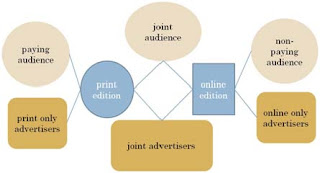
Commercial media have faced product and price challenges in 2-sided markets for more than a century, but are encountering greater difficulties in getting it right as they try to effectively monetize multi-sided markets. 2-sided and multi-sided markets are ones in which more than one set of consumers must be addressed and there is an interaction between strategies and choices for each set of customers. Prices for one group of consumers affects their consumption quantity and this, in turn, affects the prices for and consumption by the other groups. Optimal revenues can only be achieved by dealing with all groups of consumers simultaneously. Newspapers are a classic example of 2-sided platforms. The first product is the content sold to audiences and the second is access to audiences that is sold to advertisers. This has been the basis of the mass media business model since late 19th century and the strategy has been to keep circulation prices low to attract a mass audience and then to mak...

THE BATTLE TO CONTROL ONLINE PRICES

The struggle to control prices of digital content sold online continues, with producers and distributors battling over prices for downloads of books and music. In the latest skirmish, Amazon removed Macmillan books from its website after the company protested that online retail was using monopoly power to force publishers to accept prices no higher than $9.99. Macmillan and other publishers have now signed distribution deals with Apple that allows them to price downloads at $12.99 and $14.99. Producers, of course, want higher prices because they produce higher revenue and better profits. The struggle to control prices is not unique to the online environment. In the offline world, producers of books, magazines, CDs, and DVDs have long struggled to gain limited shelf space because there is a large oversupply of products and retailers’ have selection preferences for popular, rapidly selling products. Large national and retailers have also used their bargaining power to push wholesale and...

MEDIA, INNOVATION, AND THE STATE

There is a growing chorus for governments to help established media transform themselves in the digital age. From the U.S. to the Netherlands, from the U.K. to France, governments are being asked to help both print and broadcast media innovate their products and services to help make them sustainable. State support for innovation is not a new concept. Support of cooperate research initiatives involving the state, higher education institutions, and industries has been part of national science and industrial policies for many decades. There has been significant state support for innovation of agriculture/food products, electronics, advanced military equipment, information technology, and biomedical technology and products. State support tends to work best in developing new technologies and industries and tends to focus support on advanced basic scholarly research through science and research funding organizations, creation and support for research parks and industrial development zones f...

JOURNALISM AS CHARITY AND ENTREPRENEURSHIP

Many journalists pursuing new online initiatives are learning that good intentions are not enough for providing news. The latest group to do so is former Rocky Mountain News reporters who started rockymountainindependent.com this past summer using a membership payment and advertising model. The effort collapsed Oct. 4 with them telling readers, “We put everything into producing content and supporting our independent partners, but we can no longer afford to produce enough content to justify the membership.” There problem is hardly unique. The conundrum facing many journalists is whether to pursue the noble work of journalism as unpaid charitable work or to become engaged as journalistic entrepreneurs with a serious attitude toward its business issues—something many despised in their former employers. If journalists want pay for their work, if they want to provide for their families, and if they want to pay mortgages, they need to spend more time figuring out how to provide value that wi...

4 STRATEGIC PRINCIPLES FOR EVERY DIGITAL PUBLISHER

As publishers move more and more content to the Internet, mobile services, and e-readers, these digital activities change the structures and processes of underlying business operations. Many publishers, however, pay insufficient attention to the implications of these changes and thus miss out on many benefits possible with digital operations. This occurs because publishers become focused on issues of content delivery and uncritically accept the fundamental elements of the processes involving platforms and intermediaries. In order to gain the fullest future benefits from the digital environment, however, publishers needs to strategically consider and direct activities involving the users, advertisers, prices, and purposes of their new platforms. In creating business arrangements with platform and service providers and intermediaries, 4 fundamental strategic principles should guide your actions: 1. Control your customer lists . The most important thing you do as a publisher is to create ...

THE TRANSACTION COST PROBLEM OF NEWSPAPER MICROPAYMENTS

The desire to monetize online news is leading some to enthusiastically promote micropayment systems. A number of the leading newspaper sites are leaning toward a cooperative payment system that will allow readers to use a single account to access material at the leading papers. Such a system will not be technically difficult to implement, but getting the price right will be a significant challenge because of transaction costs and significant differences in the economic value of articles. To create the best industry wide effects, a micropayment payment system would need to include as many papers as possible (see "The Challenges of Online News Micropayments and Subscriptions" http://themediabusiness.blogspot.com/2009/05/challenges-of-online-news-micropayments.html ). The fact that a consortium is currently being sought only among the major players illustrates, however, that such a system would be cost inefficient because content from smaller papers would attract fewer transacti...