Posts

Showing posts with the label print media

Editing, the Richness of Content, and the Current Limits of Web and Social Media

Editors matter. The March 28-April 4, 2011, edition of the struggling news magazine Newsweek —which I admittedly have not read in years— provides some of the finest articles I have read in many months, illustrates the limits of online and social media, and shows why editors matter. There is great benefit from both edited and unedited media and I don’t believe they have to be seen in dichotomous choices for the future of media. But I believe those who argue they don’t need to edited media doom themselves to narrowness and ignorance. If I relied only on the links I receive daily from colleagues on Facebook, my news alerts for topics of interest, or digital listings of stories, I would miss the most important contribution of edited media—the service editors provide by reviewing and thinking about the world and putting journalists to work to provide a coordinated understanding of the available information. This week’s Newsweek epitomises that reality. Although I often have my attentio...
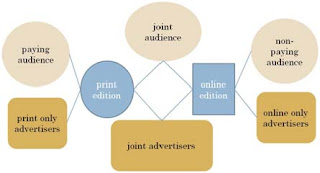
Challenges of Product Choices and Prices in Multi-Sided Media Markets

Image
Commercial media have faced product and price challenges in 2-sided markets for more than a century, but are encountering greater difficulties in getting it right as they try to effectively monetize multi-sided markets. 2-sided and multi-sided markets are ones in which more than one set of consumers must be addressed and there is an interaction between strategies and choices for each set of customers. Prices for one group of consumers affects their consumption quantity and this, in turn, affects the prices for and consumption by the other groups. Optimal revenues can only be achieved by dealing with all groups of consumers simultaneously. Newspapers are a classic example of 2-sided platforms. The first product is the content sold to audiences and the second is access to audiences that is sold to advertisers. This has been the basis of the mass media business model since late 19th century and the strategy has been to keep circulation prices low to attract a mass audience and then to mak...

SEARCH FOR ALTERNATIVE MEDIA BUSINESS MODELS HAMPERED BY NARROW THINKING

Media executives around the globe are clamoring for new and alternative business models and industry associations everywhere are holding seminars and conferences on how to create and discover them. There is just one problem: They don’t know what business models are. When you cut through the rhetoric, you find that most executives are merely interested in finding new revenue streams. Even when you consider firms touted as having best practices in that regard, none have been very successful in establishing them. The reason is simple: The dominant thought about business models is highly limited and far too narrow to solve the contemporary challenges of media industries. Business models are not merely about the revenue streams. Instead, they establish the underlying business logic and elements. They involve the foundations upon which businesses built, such as companies’ competences, value created, products/services provided, customers served, relationships established with customers and pa...

THE BATTLE TO CONTROL ONLINE PRICES

The struggle to control prices of digital content sold online continues, with producers and distributors battling over prices for downloads of books and music. In the latest skirmish, Amazon removed Macmillan books from its website after the company protested that online retail was using monopoly power to force publishers to accept prices no higher than $9.99. Macmillan and other publishers have now signed distribution deals with Apple that allows them to price downloads at $12.99 and $14.99. Producers, of course, want higher prices because they produce higher revenue and better profits. The struggle to control prices is not unique to the online environment. In the offline world, producers of books, magazines, CDs, and DVDs have long struggled to gain limited shelf space because there is a large oversupply of products and retailers’ have selection preferences for popular, rapidly selling products. Large national and retailers have also used their bargaining power to push wholesale and...

IMPLICATIONS OF CHANGING DEFINITIONS OF MEDIA MARKETS

An important contemporary development is the shift of media market definitions from traditional platform-based definitions to functional definitions. This is occurring because media product platform definitions are losing their specificity and uniqueness due to digitalization and cross-platform distribution developments. Newspapers are becoming news providers, delivering news and information via print, online, mobile, and other platforms; broadcasters are moving off the radio spectrum, exploiting not only other streaming and video-on-demand opportunities, but also text-based communication on web and mobile platforms. Although functional definitions clarify what companies actually do, they obscure wide differences in audiences, business relations, and revenue sources on the different platforms and give some the mistaken impression that a functionally defined operation can be successful operating the same way across the different platform environments. The functional definition is also c...

MEDIA, INNOVATION, AND THE STATE

There is a growing chorus for governments to help established media transform themselves in the digital age. From the U.S. to the Netherlands, from the U.K. to France, governments are being asked to help both print and broadcast media innovate their products and services to help make them sustainable. State support for innovation is not a new concept. Support of cooperate research initiatives involving the state, higher education institutions, and industries has been part of national science and industrial policies for many decades. There has been significant state support for innovation of agriculture/food products, electronics, advanced military equipment, information technology, and biomedical technology and products. State support tends to work best in developing new technologies and industries and tends to focus support on advanced basic scholarly research through science and research funding organizations, creation and support for research parks and industrial development zones f...

PUBLISHERS URGE MORE PUBLIC AID FOR NEWSPAPERS, BUT H.R. 3602 WON'T SOLVE THEIR PROBLEMS

The push for government support for newspaper continues and this week publishers and their supporters—including the Newspaper Association of America—went before the House Joint Economic Committee detailing how the current economic climate has harmed their finances and arguing for preferential changes to tax and pension laws. They asked to be allowed to extend application of the net operating loss provisions from 2 years to 5 years and for changes in laws to allow them to underfund pension funds for a greater period of time. Both would improve their operating performance and balance sheets. This is a case of the newspaper industry seeking long-term business benefits to solve a short-term crisis caused by poor management decisions and the recession. The leading newspaper firms and their representatives are making concerted efforts to dupe legislators and the public into believing their troubles are part of the general trends in the industry, rather than the result of management decisions...

THE TRANSACTION COST PROBLEM OF NEWSPAPER MICROPAYMENTS

The desire to monetize online news is leading some to enthusiastically promote micropayment systems. A number of the leading newspaper sites are leaning toward a cooperative payment system that will allow readers to use a single account to access material at the leading papers. Such a system will not be technically difficult to implement, but getting the price right will be a significant challenge because of transaction costs and significant differences in the economic value of articles. To create the best industry wide effects, a micropayment payment system would need to include as many papers as possible (see "The Challenges of Online News Micropayments and Subscriptions" http://themediabusiness.blogspot.com/2009/05/challenges-of-online-news-micropayments.html ). The fact that a consortium is currently being sought only among the major players illustrates, however, that such a system would be cost inefficient because content from smaller papers would attract fewer transacti...

OMG! NEWSPAPERS MAY NOT BE DEAD!

Success in businesses is not the result of highly mysterious factors. To be successful an enterprise must offer a product or service that people want; it must provide it with better quality and service than other providers—or at a lower price than competitors; it must change with the times and demand; and it must never forget to focus on customer needs rather than its own. And a limited number of competitors helps. Duh. Many journalists have trouble understanding these principles, however, and we were treated to 2 classic stories in which journalists breathlessly announced this discovery over the weekend. The New York Times told us about the “resurgent” Seattle Times. The Times is starting to reap the fruits of monopoly caused by the demise of the print edition of the Post-Intelligencer and the stabilizing economy. It has picked up most of the print readers from the P-I, raised its circulation prices, and been able to keep the higher ad rates that were charged when ads were put in both...

DOES ONLINE NEWS STILL NEED OFFLINE TIES?

When the Seattle Post-Intelligencer ceased publication in mid-March it continued www.seattlepi.com as a web-only publication. It employs 20 persons, making it one of the largest online staffs of any local Internet news organization. Although it has a much smaller staff than the print edition did, the site continues to cover local news and sports, provides national and international feeds, and features local bloggers. In many ways it is what many observers have called the future of post-print journalism. It is well recognized that print is an expensive way to convey news, information, and commentary so observers argue that the Internet is the answer for community informational needs because the public is increasingly getting their news there anyway. It is still early days for forming a definitive view of how dropping print may affect online demand, but the P-I’s situation gives a unique opportunity to observe effects. In February—before the print edition closed—the website had 1.8 milli...

ANALYSIS OF THE NEWSPAPER REVITALIZATION ACT

The Newspaper Revitalization Act introduced by Sen. Benjamin Cardin, D-Md., would permit newspapers to operate as not-for-profit entities under the tax code and is being heralded by some observers as a means of saving newspapers, much as was the Newspaper Preservation Act of 1970. Good purposes aside, it is useful to study the act to determine whether it will actually accomplish the goals that are stated as its rationale. The bill is a small bill, about 435 words, that would amend the IRS Code of 1986 to permit newspapers to be given 501(c)(3) status, thus obtaining tax exempt status and the ability to accept charitable contributions. Currently tax laws do not permit newspapers to be operated tax exempt, but they do have mechanisms that permit foundations to own them or support them financially. Paragraph (b)(1) of the bill would allow general circulation newspapers “publishing on a regular basis” to establish themselves as tax exempt organizations. The language does not limit periodic...

THE OVERBLOWN JOURNALIST EMPLOYMENT CRISIS

Journalists keep raising the crescendo of the chorus that journalists are losing their jobs and journalism is suffering. They point to the fact that about 10 percent of journalists have disappeared from newspapers since the millennium when U.S. newsroom employment reached a peak of 56,373. It is true that cutbacks are pandemic these days, and that these employment reductions hit close to home for journalists, but some context is usually useful when considering the numbers and their impact. Let’s take a look at the U.S. numbers. The American Society of Newspaper Editors has conducted a newsroom employment census for 3 decades and it presents a telling story. According to the latest ASNE newsroom employment figures, there are 22 percent more journalists in newspapers than there were in 1977 (43,000 in 1977; 52,600 in 2007). Even granting employment losses of 2,000-4,000 since the last census, employment is still about 18 to 20 percent higher than it was in the 1970s. That doesn't see...

NEWSPAPER RESTRUCTURING IS PAINFUL, BUT NECESSARY

Financial pages are full of developments and changes at newspaper companies and these are being commented upon anxiously by those in the industry. Unpleasant conditions certainly abound, but these development are not indications that the industry is dead or dying in the near future. What they signal is that things which worked in the past are not working now, that newspaper companies are badly in need of restructuring, refocusing, and renewal, and that the boards of the companies and the company managers are taking badly needed action. The techniques for restructuring are no mystery. First, you need some cash. This can be obtained by attracting new capital through investment or loans. New York Times Co. did this recently by borrowings $250 million from Carlos Slim. Other firms are looking for friendly investors with liquidity. Another way of raising cash is by turning assets into cash. A classic move made by many types of firms is the sell their building and lease back any space that i...

THE CREDIT CRISIS, VOLATILE MARKETS, RECESSION AND MEDIA

The churning flood of economic developments and the desperate measures of governments to lay financial sandbags to control the torrent present not one, but three calamities for media managers. Those that escape one may well be swept away by another. Most media can survive the collapse of credit markets because media firms have high cash flows are typically require less short term credit than manufacturing and retail firms. Because most can acquire their most important resources without accessing credit lines or issuing commercial paper, banks struggling to keep their heads above water are not a major short-term concern. However, those media firms with large debts due in the short-term that were hoping to refinance face significant hurdles. Some will be rapidly shedding media properties in order to stay afloat. The more immediate problem for some publicly owned firms is the financial damage caused by the dramatic drop in share prices following the credit market collapse. Because a numbe...

DISSAPEARANCE OF A FINANCIALLY GOLDEN NEWSPAPER PERIOD

Voices in and around the newspaper industry would have us believe the industry is falling apart and taking its last gaps. Investors are fleeing newspaper companies, publishers are decrying the lack of newspaper advertising growth, debt challenges are plaguing many companies, and there are layoffs and buyouts everywhere. If one rationally looks at the industry, however, one sees that it is fundamentally sound, but that a unique, financially golden period in its history is ending. It is that change which is creating the bulk of the turmoil in the industry, but the biggest problem is that those working in the industry have short memories about the newspaper business and don't remember it any other way. The generation leading newspapers and newspaper companies today has only experienced a period in which extraordinary growth of advertising increased newspaper revenue across the nation. That growth, combined with the development of local monopolies, created a period that enriched papers...

THE CAPITAL CRISIS IN THE NEWSPAPER INDUSTRY DEEPENS

Recent weeks have not been kind to newspaper company finances, with lost value and unhappy investors plaguing publicly traded firms. The Journal Register Co. was delisted from New York Stock Exchange because it share price remained below $1, reducing its market capitalization about $12 million, less than one-fifth the capitalization required to be traded on the big board. The Sun-Times Media Group stock also continued trading below $1 and its market capitalization dropped to $61 million, drawing a delisting warming from the New York Stock Exchange. Although those firms have hardly been notable as the best managed firms in recent years, their problems in inspiring investors are symptomatic of difficulties facing newspaper firms in the market. Meanwhile, Moody’s Investors Service lowered the New York Times and McClatchy Co. debt ratings and lowered the Gatehouse Media even further in the junk category. Other firms are also having problems with capital related issues. Rumors are rampant t...

THE INTERNET, MOBILE MEDIA, AND YOUTH ARE NOT TO BLAME

Traditional media industries and companies are overwhelmed with an atmosphere of consternation and fear today. Trade publications and industry association meetings are filled with news of diminished budgets, reorganizations, consolidations, and layoffs. People say traditonal media are declining and will soon disappear. Potential employees are wondering if there is a future for them in the industries and senior employees are hoping their jobs will last until they reach retirement. Everyone is pointing the finger,but most of the blame for killing traditional media is laid on the Internet, mobile media, and young people. There is just one problem with their scenario. IT’S NOT TRUE. We have deluded ourselves into thinking that well established media are dying and that young people are uninterested in traditional text and audiovisual media. Although new distributors of information and entertainment abound and video on demand and consumer-created content are increasing daily, consumers’ grea...